
Introduction
Since a few people on social media have challenged my conclusion that Israel is committing genocide against Palestinians in Gaza since the Hamas attack on 7 October 2023, I feel a need to formally lay out a short version of why I believe this to be true.
First, I will briefly outline efforts to negotiate a cease fire agreement and the current state of affairs. From there I will proceed with some definitions and then present evidence that Israeli conduct of the war against Hamas in Gaza meets the criteria for genocide and that Israeli rhetoric supports this conclusion. I rely heavily on a UN Commission Report, news articles, and reports from Israeli human rights groups.
Efforts to End the Fighting
This is an ongoing war, and facts on the ground are changing. In November 2023 the Biden Administration, in collaboration with Qatar, negotiated a cease fire and what amounted to a hostage/prisoner swap. Fighting resumed on 1 December 2023 when both sides accused the other of violating its terms.
The two sides concluded another cease fire in January 2025, this one to be implemented in three phases. The first phase saw another hostage/prisoner exchange, Israeli withdrawal from Gaza, and resumption of humanitarian aid. Future phases would have included further exchanges of hostages and prisoners, discussions on the specifics of a permanent cessation of hostilities, demilitarization of Gaza, and peacekeepers or mediators to monitor the truce. This deal broke down largely because President Biden’s term ended, and two weeks after Trump took office, on 4 February 2025, he announced his intention to expel Palestinians from Gaza and for the US to take control of the territory. This amounted to a green light to Isreal to do as they pleased and hostilities resumed when Israel launched a surprise attack on 18 March, 2025. This attack included the bombing of a hospital complex that killed more than 400 people and wounded another 500. Israel accused Hamas of forcing it to resume hostilities by delaying the return of bodies of Israelis who died in captivity, thus ending the cease fire.
Hamas and Israel agreed to a third cease fire, also a phased cease fire, on 10 October 2025. This 20-point plan, presented by Trump in an apparent effort to win a Nobel Peace Prize (he didn’t), would become effective in three phases. The first phase terms included an Israeli military withdrawal to agreed-upon positions, release of all 48 hostages held by Hamas, including those who have died since military operations began, subsequent release of 250 Palestinians convicted or suspected of security crimes as well as about 1700 Palestinians detained in Gaza during operations, and repatriation of Hamas fighters killed. Prisoners convicted of killing Israelis would be released but barred permanently from entering Israel or the West Bank. Additionally, Israel would end their blockade of the Gaza Strip and allow humanitarian aid such as food and medications as well as materials and equipment needed to begin repairing damaged infrastructure.
The second phase would include demilitarization of Hamas and Gaza, “de-radicalization” of the territory, and a stabilization (peace-keeping) force of US, Arab, and European personnel. These peacekeepers would also train a Palestinian police force created to ensure stability and peace. Stakeholders would establish a Palestinian Committee during phase three to oversee day-to-day governance and reconstruction, including support for Palestinians who choose to stay and rebuild. The ultimate goal, should de-radicalization, reconstruction, and reform of the Palestinian Authority proceed peacefully, is acknowledgement of Palestine as a state.
Most diplomats consider this more of a pause than a cease fire, and facts on the ground seem to confirm this perception. Israel has accused Hamas of violating the truce by delaying transfer of some remains, an allegation that Hamas planned to crack down on Palestinian clans inside Gaza who support Israel, and a few small claims that Hamas had fired on Israeli troops. For their part, Israel has conducted aerial and drone strikes within Gaza that killed at least 7 Palestinians, closed the Rafah border crossing and reduced humanitarian aid, and conducting further air strikes on October 19. If we call this a war, it has not ended; both sides have refused to move to the second phase.
Definitions
Before discussing whether Israel is actively trying to destroy the Palestinian people as a group, and/or cleanse the Gaza strip of Palestinians, we need to settle on definitions. A dictionary might say something like “deliberate and systematic killing or persecution of a large number of people from a particular national or ethnic group with the aim of destroying that nation or group.”
- Killing members of the group;
- Causing serious bodily or mental harm to members of the group;
- Deliberately inflicting on the group conditions of life calculated to bring about its physical destruction in whole or in part;
- Imposing measures intended to prevent births within the group;
- Forcibly transferring children of the group to another group.
When referring to ethnic cleansing, I’ll use this definition from Britannica:
“The attempt to create ethnically homogeneous geographic areas through the deportation or forcible displacement of persons belonging to particular ethnic groups. Ethnic cleansing sometimes involves the removal of all physical vestiges of the targeted group through the destruction of monuments, cemeteries, and houses of worship.”
Several human rights organizations, including Israeli groups, have investigated this question: has Israel conducted a campaign of genocide and/or ethnic cleansing in Gaza since the Hamas attacks two years ago? I’ll rely heavily on a United Nations report, supplemented by other sources.
Two years before the Hamas attack, on 27 May 2021, the United Nation Human Rights Council (UNHRC) created the Independent International Commission of Inquiry on the Occupied Palestinian Territory, including East Jerusalem, and Israel (IICIOPT) to investigate possible war crimes and other abuses committed in Israel and the occupied Palestinian territories. The UNHRC created this Commission after the 2021 Israel-Palestinian crisis (Unity Intifada), and it has continued its work through the current crisis.
On 16 September 2025 the Commission issued a report that presented solid evidence showing that Israel committed four of the five genocidal acts under the definition and found reasonable grounds to conclude that Israel’s conduct in Gaza since October 2025 amounts to genocide under the 1948 Genocide Convention.
Troubled History
Before I lay out a sampling of this evidence, let me say that the history of conflict between Israel and surrounding Arab populations and states predates World War I. This is a deeply conflicted vestige of colonialism and too complicated to get into here. Versions of events vary depending on who you listen to, but the bottom line – a very foggy one – is that Arabs resisted an effort to create a Jewish state in Palestine after World War II with military force and Israeli forces acted to expand it. The 1947 UN Partition Plan would have reserved about half the British Mandate territory for a Jewish State, even though they were only a third of the population and owned less than ten percent of the land. Arab paramilitary forces started the violence with an attack on a bus in Lod and continued with attacks on Jewish towns and villages. Jewish forces responded, and by April 1948 were on the offensive, eventually driving more than 700K Arabs from their homes. Both sides point the “they started it” finger, and both do so plausibly, inasmuch as Arabs fired the first shot but may have felt justified if agreeing to partition meant displacing large numbers of people from family land. In any event, time has not healed these wounds, and today both sides are complicit in the failure to find a peaceful resolution because both sides make intractable demands.
Genocide?
Hamas attacked Israel on 7 October 2023 with a coordinated combined arms incursion into Israeli territory supported by more than 4300 rounds of rocket artillery and powered paraglider troops. This included attacks on civilian populations and some evidence – mostly eyewitness accounts that cannot be confirmed – suggests that Hamas fighters committed atrocities including rape and summary executions.
Israel responded with overwhelming force in defense of the State and its populations, as they of course had to do. The question I’d like to address here is whether this response, over time, became an intentional effort to decimate the Palestinian population in Gaza, eliminate it altogether, or displace it by making Gaza uninhabitable. The UN Commission report is useful here; they conclude that Israel has committed four of the five acts that amount to genocide. They also show intent – that the Israeli government intends to cleanse Gaza of Palestinians on purpose – by quoting Israeli government officials.
The first two are easy ones. According to the Commission report, by 31 July 2025 Israeli attacks had killed more than 60K people, including 18K children, and inflicted serious bodily harm on 78K more. Other sources confirm the general scale. Israel also acted to increase casualties by carrying out 500 attacks on health care facilities that killed women, some of them pregnant, and children. They acted to cut off humanitarian aid such as food and medicine, which will lead to future casualties from starvation and disease (blockades of food and medicine to Gaza actually began in some form long before the 7 October attacks). They attacked evacuation routes and designated safe areas. Supporters of Israel argue that Hamas hid operations centers and fighters in health care facilities and safe areas, but Israel has not provided evidence to support this claim or allowed aid workers or journalists to investigate. Indeed, some evidence suggests that Israel has targeted aid workers and journalists, many in a series of strikes on a hospital.
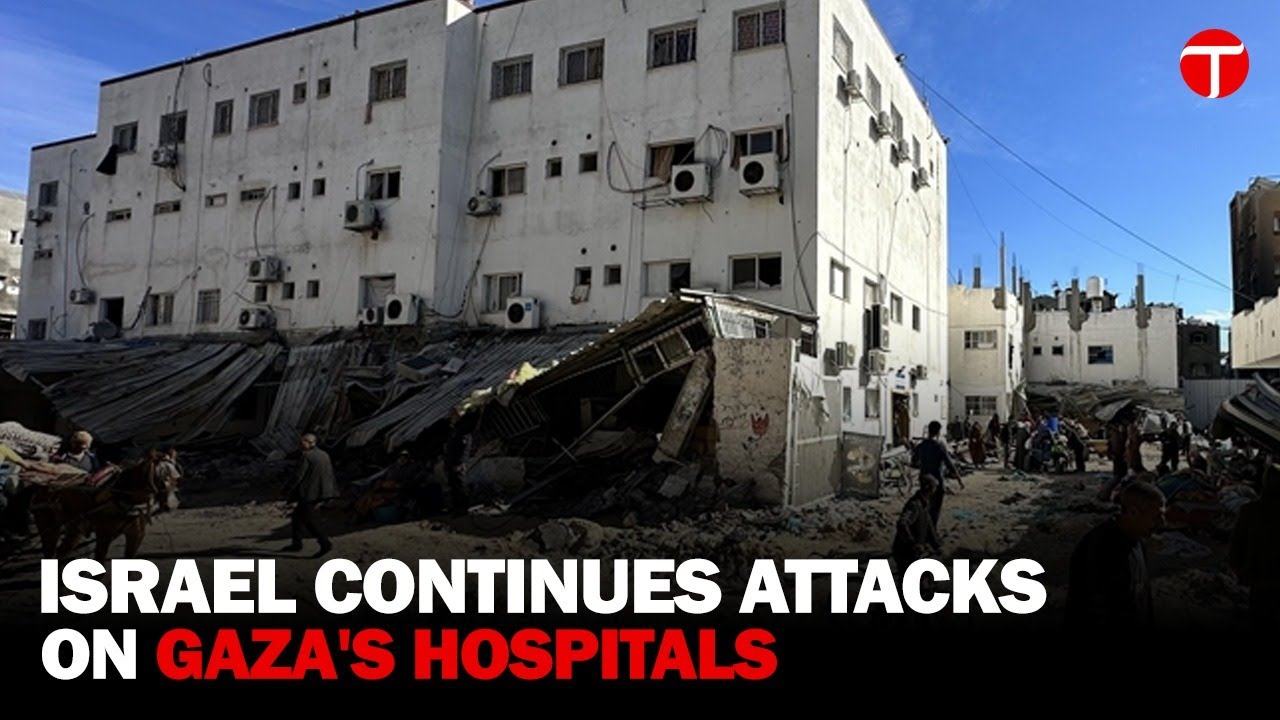
Photo by Miriam Dagga, a freelance journalist killed by the second strike on this hospital as people helped the wounded. Journalist’s Final Images Show the Gaza Hospital Stairwell Where She Was Killed by an Israeli Strike
Israel claims that they warn civilians of impending attacks (which Hamas does not do) in an effort to reduce collateral casualties. But they killed more than 400 Palestinians in a wave of airstrikes, without warning, during a cease fire on 18 March 2025. And it’s not clear how easily civilian populations can evacuate a targeted area where food, water, fuel, and other resources needed for mass population movements are lacking. Further, the Commission presented convincing evidence that Israeli officials misrepresent the facts on the ground and offer no evidence of the claims they make.
The Commission also concludes that Israel deliberately inflicted conditions of life on Palestinians calculated to bring about its physical destruction. These conditions include deprivation of food and water, reduction or destruction of required medical services and shelter, lack of hygiene and sanitation, the systematic expulsion from and destruction of homes and withholding sufficient living accommodation. This would also include cutting off access to electricity.
Israel inflicted these conditions by destroying hospitals, schools, agricultural fields, food production facilities, and sewer systems. They conducted a blockade that cut off electricity (needed by desalinization plants that produce fresh water) and humanitarian aid. The Israeli bombing campaign left sections of northern Gaza and Khan Younis in south Gaza virtually uninhabitable. Israeli attacks also damaged at least 150 cultural and religious sites (53% of heritage sites according to the World Bank). Israeli operations displaced 1.9 million people by 25 June 2025, and evacuation orders forced the migration of another 280K.
In the immediate aftermath of the attack on 7 October, Israeli Minister of National Infrastructure, Energy, and Water ordered cessation of electricity supplies to Gaza. On 9 October, Israel imposed a blockade, cutting off essential resources and the movement of goods, heavily restricting the population’s access to water, fuel, electricity and food. Minister of Defense Yoav Gallant called this “a complete siege… no electricity, no water, no food, no fuel. We are fighting human animals, and we act accordingly.” Since December 2023 more than 90% of Gazans have experienced severe food insecurity or famine. Israel has relaxed this blockade to some degree but continues to prevent supplies to Gaza that would reduce hunger and disease.
Perhaps most disturbingly, Israeli policies also meet the fourth criteria: imposing measures intended to prevent births among Gazans. Israeli strikes have hit maternity wards, neonatal clinics, and fertility clinics. They have killed more than 1700 health care workers and counting. Israeli drones flew through hospital hallways chasing nurses and shooting at them, according to Dr. Ambereen Sleemi, a gynecologist in Gaza. The blockade has also cut supplies of food and baby formula, and at least 150 children have died of malnutrition alone.
Dolus Specialis?
All of this demonstrates that Israel has committed four of the five physical acts that constitute a criminal offense, or actus reus. Next, the Commission uses statements made by Israeli officials and the pattern of conduct of Israeli officials and security forces consistent with these statements to demonstrate dolus specialis, or specific intent. This section begins on page 48 of the Commission Report, but here are a few examples:
Defense Minister Yoav Gallant:
“Gaza won’t return to what it was before. We will eliminate everything. If it doesn’t take one day, it will take a week. It will take weeks or even months, we will reach all places.”
Knesset Member Yitzhak Kroizer:
“The Gaza Strip should be flattened, and there should be one sentence for everyone there — death. We have to wipe the Gaza Strip off the map. There are no innocents there.”
Minister of Heritage Amichai Eliyahu:
“The north of the Gaza Strip, more beautiful than ever. Everything is blown up and flattened, simply a pleasure for the eyes.” Eliyahu also said in an interview that nuclear weapons would be “one way” of destroying Gaza.
Knesset Member Ariel Kallner:
“Right now, one goal: Nakba! A Nakba that will overshadow the Nakba of 48.” Nakba is the Arabic word for the ethnic cleansing of Palestinian Arabs from much of what is now Israel during the conflicts in 1948. Minister of Agriculture Avi Dichter agreed.
Knesset Member Boaz Bismuth:
“There is no place for any humanitarian gestures — we must erase the memory of Amalek.” Amalek here refers to a staunch enemy of the Israelites in the Bible. Bismuth here uses it as a reference to the Palestinians.
IDF 36th Armored Division Commander David Bar Khalifa:
“We shall go out to … [the enemy] in war, we shall pulverize every accursed plot of land from which it came, we shall destroy it and the memory of it … and we shall not return until it is annihilated.”
Senior Security Forces Officer Erez Eshel:
“In 100 years they will know that you don’t mess with the Jews. It will take so many years to revive from this blow … this place will be a fallow land. They will not be able to live here.” Sounds like ethnic cleansing, if not genocide, to me.
Knesset Member Galit Distel-Atbaryan:
“Hate the enemy. Hate the monsters. Any shred of internal bickering is a crazy and terribly stupid waste of energy. Invest that energy in one thing: erasing all of Gaza from the face of the earth. That the Gazan monsters will fly to the southern fence and flee into Egyptian territory. Or they will die … Gaza needs to be erased.”
Coordinate or Government Activities in the Territories Ghassan Alian:
“Human animals are dealt with accordingly. Israel has imposed a total blockade on Gaza — no electricity, no water, just damage. You wanted hell, you will get hell.”
Adviser to the Minister of Defense and IDF Major General Giora Eiland:
“This is what Israel has begun to do — we cut the supply of energy, water and diesel to the Strip … But it’s not enough. In order to make the siege effective, we have to prevent others from giving assistance to Gaza … The people should be told that they have two choices; to stay and to starve, or to leave. If Egypt and other countries prefer that these people will perish in Gaza, this is their choice.”
“The State of Israel has no choice but to make Gaza a place that is temporarily, or permanently, impossible to live in.”
“Gaza will become a place where no human being can exist.”
“Who are the ‘poor’ women of Gaza? They are all the mothers, sisters or wives of Hamas murderers. On the one hand, they are part of the infrastructure that supports the organization … When senior Israeli figures say in the media ‘It’s either us or them’ we should clarify the question of who is ‘them’. ‘They’ are not only Hamas fighters with weapons, but also all the ‘civilian’ officials, including hospital administrators and school administrators, and also the entire Gaza population who enthusiastically supported Hamas and cheered on its atrocities on October 7th.”
Knesset Member Meirav Ben-Ari:
“And the children in Gaza – the children in Gaza have brought this upon themselves!”
Deputy Knesset Speaker Nissim Vaturi:
“[Now] we all have one common goal — erasing the Gaza Strip from the face of the earth.”
Knesset Member Tally Gotliv:
“May your village burn!! Yes, yes, from my perspective, it’s great morale to wish Gaza to be wiped out and set on fire.”
These are some pretty damning statements, and demonstrate Israeli intent to destroy Gaza, make the place uninhabitable, and thereby either destroy the Palestinian people or cleanse Gaza of their presence. The Commission Report lists more examples and connects them to specific patterns of conduct.
All of this demonstrates that Israeli officials want to take military operations far beyond military necessity as an exercise in self-defense and securing the release of Israeli hostages. Their actions, the consequences of their actions, and their own words show other motivations, including vengeance and collective punishment.
Of the many important issues facing us today, this one requires very difficult conversations, and both sides tend to ignore evidence and data that makes them look like bad guys. Both sides dismiss evidence contrary to their views and use epithets to shut down conversation. Israel and its supporters charge anyone who challenges them with antisemitism or support for Islamic terrorism they don’t feel. Critics of Israel complain of Jewish conspiracies that aren’t there.
Still, the conversation is necessary and calling me an antisemite because of my views on this will not shut me down. I will have more on this issue, including a look at Hamas and their own war crimes and atrocities. In the meantime, please let me know what you think.