War in Iran? The US Military in Aggressive Wars

Trump is apparently expanding the US military presence in the Middle East, a possible buildup to an attack on Iran. The why of this is important, since it involves nuclear capability, Israel, and quite possibly some corrupt scheme to line Trump’s pockets by either getting a payoff for stopping the attack or a payoff for executing it. All-in-all an interesting development for a President who just scammed $10B from American taxpayers for his “Board of Peace,” which itself raises interesting Constitutional questions about that whole Advise and Consent clause that requires Senate approval for treaties.

A post – or podcast episode – for another day. For now, this got me to thinking about US military leaders and how I would expect them to react if given orders to conduct offensive operations in support of an expansionist fascist regime.

We already know they will conduct offensive operations against both nation states and non-state actors given a plausible national security and moral argument, however specious (see Viet Nam and Communist expansion).

What would it take to get them on board with an openly expansionist foreign policy? To capture Greenland by force….then Cuba…Panama (the stole our canal, after all)? He’s openly spoken about invading all these countries, plus Mexico, on a “go after the cartels” pretext.

Continue reading
Pandemic and National Security

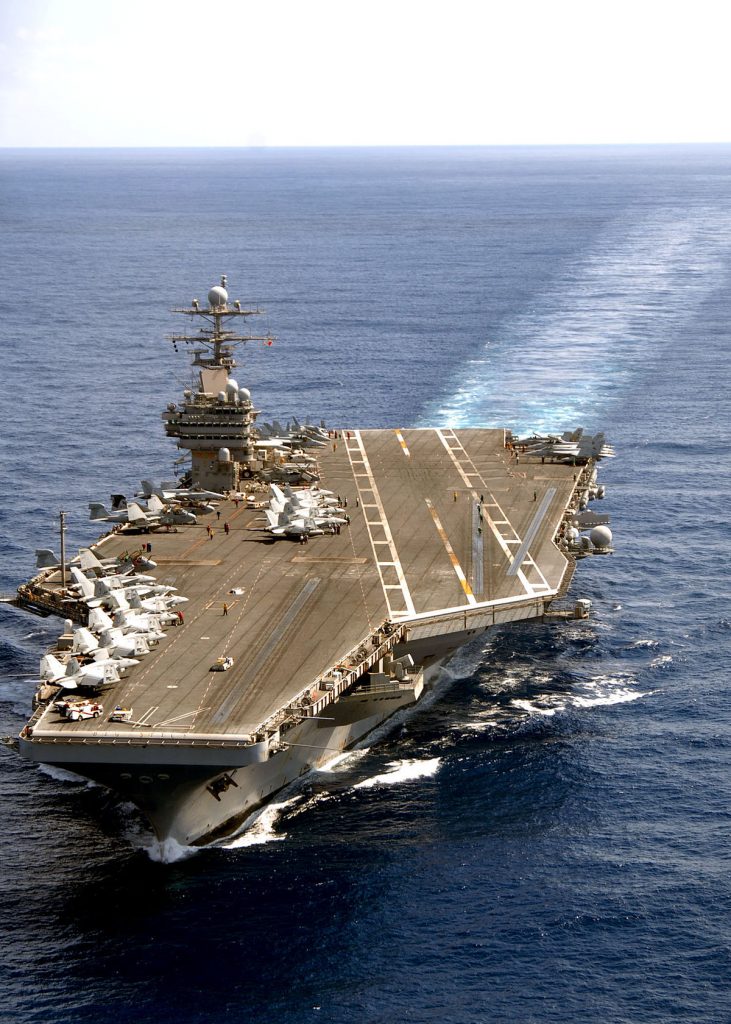
USS Theodore Roosevelt (CVN-71).
U.S. Navy photo by Mass Communication Specialist 2nd Class Michael D. Cole
Public Domain,
http://www.navy.mil/view_image.asp?id=57046

One of three deployed US aircraft carriers has been sidelined by corona virus infections on board. This pandemic has, at least temporarily, taken this warship out of the fight. I would be surprised if it’s the only one, but even if it is we’re looking at a serious erosion of American war fighting capability.

The USS Theodore Roosevelt, a Nimitz class nuclear aircraft carrier, has a crew of about 3200, not including its associated Air Wing. More than four thousand Naval personnel were on the Theodore Roosevelt when the vessel docked in Guam with more than 100 crew members testing positive for the virus, according to the linked article.

Continue reading

From the Archives: The State of War (Originally posted on July 3, 2007)

Semi-academic essay arguing for criminalizing international terrorism and constructing institutions to fight it as a crime vice using military force against states.  Basically a recount of the literature on the changing nature of war between States and the rise of non-state actors as managers of violence across borders.

Should probably update in light of Russia’s recent seizure of the Crimea from the Ukraine.  “Protecting our tribal cousins in other States” is certainly an excuse for invasion that once had traction – and that Finnemore argues no longer holds.  Here it did.


The State of War

The capture of 15 British sailors by Iranian naval forces on Friday brings to mind an interesting puzzle for international relations theorists: why has war between states become less common, even as fighting among groups within states more so? Several possible answers spring to mind, including the increasing cost of war between states as military power becomes more destructive, the growing interdependence between states as globalization proceeds apace, and the desire by intrastate groups to achieve the sovereignty required to be the masters of their own affairs.

Until the invasion of Iraq by the US in 2003, it seemed that states had begun to agree on sovereignty principles that would “lock in” frontiers and create enormous stigma against changing them. States had, before World War II, accepted war in the name of territorial acquisition, dispute resolution, or punitive action. By the end of the Cold War they supported military action across state borders to stop genocide (Bosnia), protect humanitarian projects (Somalia), or to stop aggressive states (Iraq 1991), though even this principle was unevenly applied. It looks like one effect of the Bush Doctrine has been to reopen the sovereignty norm to conquering states, and by extension force states to become more defensive of their frontiers. If this is so, it makes the world a more dangerous place.

The literature on sovereignty is extensive—the rules establishing the nature of the state, how they form, live, and die, and systemic interactions among them call for intensive study of their origin, application, and legitimacy. Research into the application of sovereignty has blossomed with the idea that globalization has somehow diluted the power of the state by limiting state action and empowering new actors such as international organizations, advocacy groups, and corporations. In the last few years, scholars have published several books on the changing nature of sovereignty and the impact of these changes on the use of violence among international actors. Continue reading

From the Archives: The State of War (March 25, 2007)

The State of War

The capture of 15 British sailors by Iranian naval forces on Friday brings to mind an interesting puzzle for international relations theorists: why has war between states become less common, even as fighting among groups within states more so? Several possible answers spring to mind, including the increasing cost of war between states as military power becomes more destructive, the growing interdependence between states as globalization proceeds apace, and the desire by intrastate groups to achieve the sovereignty required to be the masters of their own affairs.

Until the invasion of Iraq by the US in 2003, it seemed that states had begun to agree on sovereignty principles that would “lock in” frontiers and create enormous stigma against changing them. States had, before World War II, accepted war in the name of territorial acquisition, dispute resolution, or punitive action. By the end of the Cold War they supported military action across state borders to stop genocide (Bosnia), protect humanitarian projects (Somalia), or to stop aggressive states (Iraq 1991), though even this principle was unevenly applied. It looks like one effect of the Bush Doctrine has been to reopen the sovereignty norm to conquering states, and by extension force states to become more defensive of their frontiers. If this is so, it makes the world a more dangerous place. Continue reading